

Import, distribution, and installation system for vinyl flooring, laminate flooring, sheet vinyl, and carpets
Laminate Flooring is one of the most diverse flooring materials available today. With countless varieties in core material, color, and grain patterns, laminate flooring is divided into many types, each suited for different uses.
Understanding the different types of laminate flooring will help you easily choose the right option for your needs, budget, and the environmental conditions of each space.
Today, laminate flooring can be classified based on several common criteria such as: thickness, core material, price, or product origin.
Laminate Flooring ranges in thickness from 4mm to 15mm. Among these, the two most commonly used types are 8mm and 12mm, as they suit most installation requirements in residential and commercial projects.
8mm Laminate Flooring
This type offers an affordable price, meeting basic usage needs in spaces with moderate foot traffic. However, due to the thin board, its load-bearing capacity and sound insulation are limited. If the subfloor is not properly prepared, users might notice echoes or a slightly “bouncy” feeling when walking.

An Cuong AC-1161-BT Laminate Flooring
Retail price: 310,000 VND/m²

An Cuong AC-388-RL Laminate Flooring
Retail price: 310,000 VND/m²

An Cuong AC-4002-PL Laminate Flooring
Retail price: 310,000 VND/m²

An Cuong AC-4003-PL Laminate Flooring
Retail price: 310,000 VND/m²

An Cuong AC-4004-RL Laminate Flooring
Retail price: 310,000 VND/m²

An Cuong AC-4005-RL Laminate Flooring
Retail price: 310,000 VND/m²

An Cuong AC-4006-RL Laminate Flooring
Retail price: 310,000 VND/m²

An Cuong AC-4007-PL Laminate Flooring
Retail price: 310,000 VND/m²
12mm Laminate Flooring
Belonging to a higher segment, this type of flooring has greater thickness, providing a more solid and stable feel during use. When walking, the floor feels firm, smooth, and closely resembles the experience of natural wood flooring.
Comparison Table: 8mm vs. 12mm Laminate Flooring
Criteria | 8mm Flooring | 12mm Flooring |
Common Abrasion Resistance Standard (AC) | AC3 - AC4 | AC4 - AC5 |
Sound Insulation | Moderate | Very Good |
Cost | Low, economical | Higher, commensurate with quality |
Applications | Homes, offices, stores, showrooms… | High-end apartments, villas, hotels, resorts, etc. |
The core material is the factor that determines the hardness, load-bearing capacity, and water resistance of laminate flooring. Depending on the pressing density and manufacturing technology, laminate flooring currently mainly uses 3 different types of core material, with HDF (High Density Fiberboard) being the most common.
HDF is a high-density fiberboard (800 - 950 kg/m³) pressed under high pressure, creating a sturdy and stable structure. Thanks to its hard and relatively good moisture-resistant properties, HDF core is widely used in most laminate flooring lines today.
Based on color and identifying characteristics, HDF core material is often divided into two sub-groups:
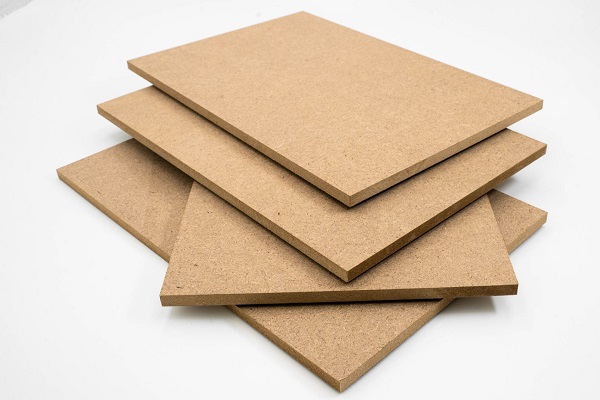
Brown HDF Core is divided into two different quality lines:
Standard type (commonly found in Vietnamese laminate flooring, inexpensive Chinese laminate flooring): The core is light brown, with moderate pressing density, resulting in average water resistance.
Premium type (Malaysian laminate flooring, 100% imported European laminate flooring): The core is dark brown, similar to natural wood, with high pressing density, providing better hardness, water resistance, and anti-termite properties (notably brands like Robina, Inovar, Kronopol).
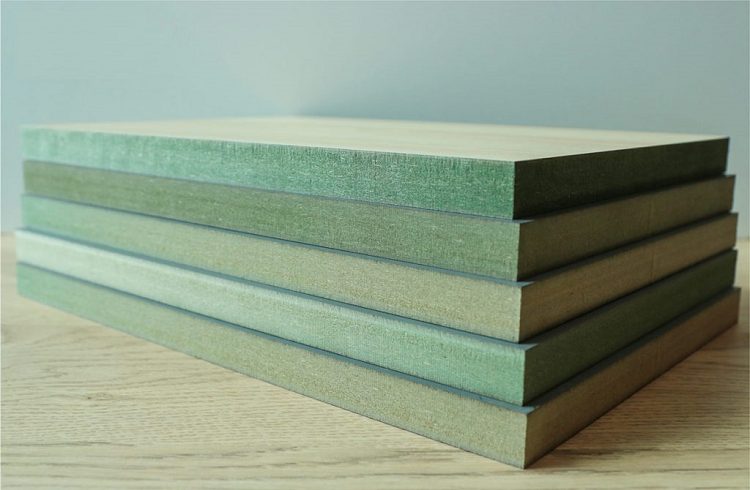
Green HDF Core
This type of core material is often found in domestic laminate flooring lines. Manufacturers add moisture-resistant additives and water-resistant glue to the wood fiber mixture, and dye it green for easy identification.
As a result, the green core has better moisture resistance than the standard brown core, making it quite suitable for humid weather conditions. However, in terms of long-term stability, some green core lines still do not achieve the same quality as premium imported brown HDF cores.
>> See more What is Green Core Laminate Flooring?
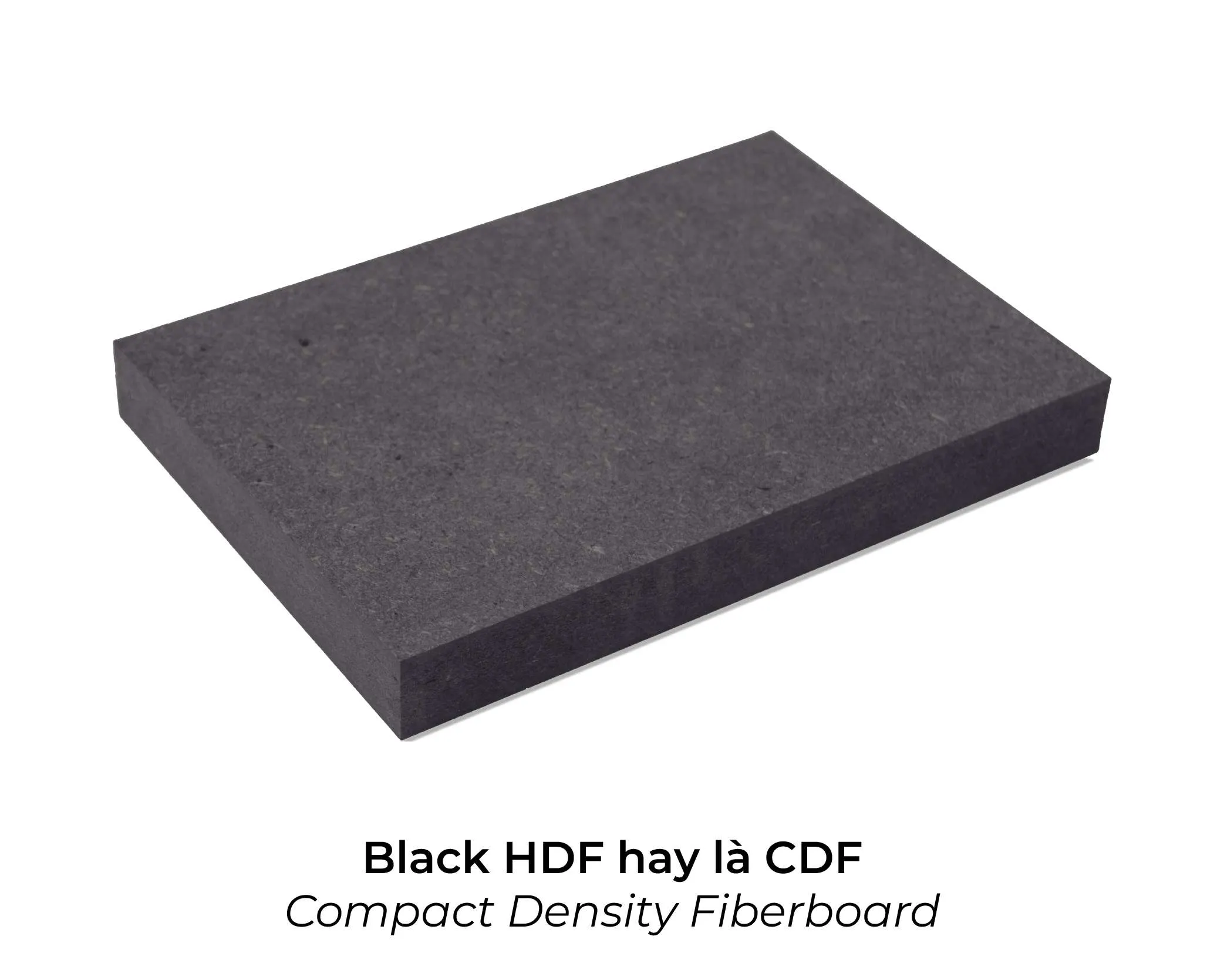
CDF is an ultra-high-density core material (1,000 - 1,200 kg/m³), considered an upgraded version of HDF. In the flooring industry, this material is also known as dense black core due to its characteristic deep black core.
Compared to regular HDF, CDF core has a very dense and hard board structure, making it highly impact-resistant. As a result, laminate flooring using CDF core has water resistance (up to about 24-72 hours) with minimal swelling.
Therefore, CDF core laminate flooring is often used in areas with high humidity or high traffic, such as ground floors, kitchens, or living spaces prone to water exposure.
MDF is a wood board with medium fiber density (approximately 670 - 780 kg/m³). Compared to HDF or CDF, MDF core has lower pressing density, thus its hardness, load-bearing capacity, and water resistance are also limited.
MDF core material is mainly used in inexpensive laminate flooring lines or industrial furniture products, suitable for dry spaces and basic usage needs.
Table of Laminate Flooring Core Types
Core Type | Identifying Characteristics | Water Resistance | Price Segment | Recommended Use |
Brown HDF (Standard) | Light brown, lightweight | Limited | Economical | Rental homes, lofts, stores, fashion shops |
Green HDF | Green core | Fair | Mid-range | Apartments, offices |
Brown HDF (Premium) | Dark brown, very hard | Excellent (top-tier) | High | All dry indoor spaces |
Black HDF/CDF | Black core, very heavy | Outstanding (Super water-resistant) | High | Damp ground floors, kitchens, high-traffic areas. |
MDF | Yellow-brown/light yellow | Limited | Economical | Dry spaces |
In addition to composition and core material, laminate flooring can also be classified by installation pattern. The arrangement of floorboards not only affects the overall aesthetics but also impacts the sense of space, depth, and interior design style.
This is the most traditional and common installation pattern today due to its flexibility and reasonable installation cost. The floorboards are installed parallel to each other, forming long rows running along the length or width of the room.
The advantages of the straight lay pattern are simple installation, minimal material waste, and suitability for most spaces such as living rooms, bedrooms, or apartments.
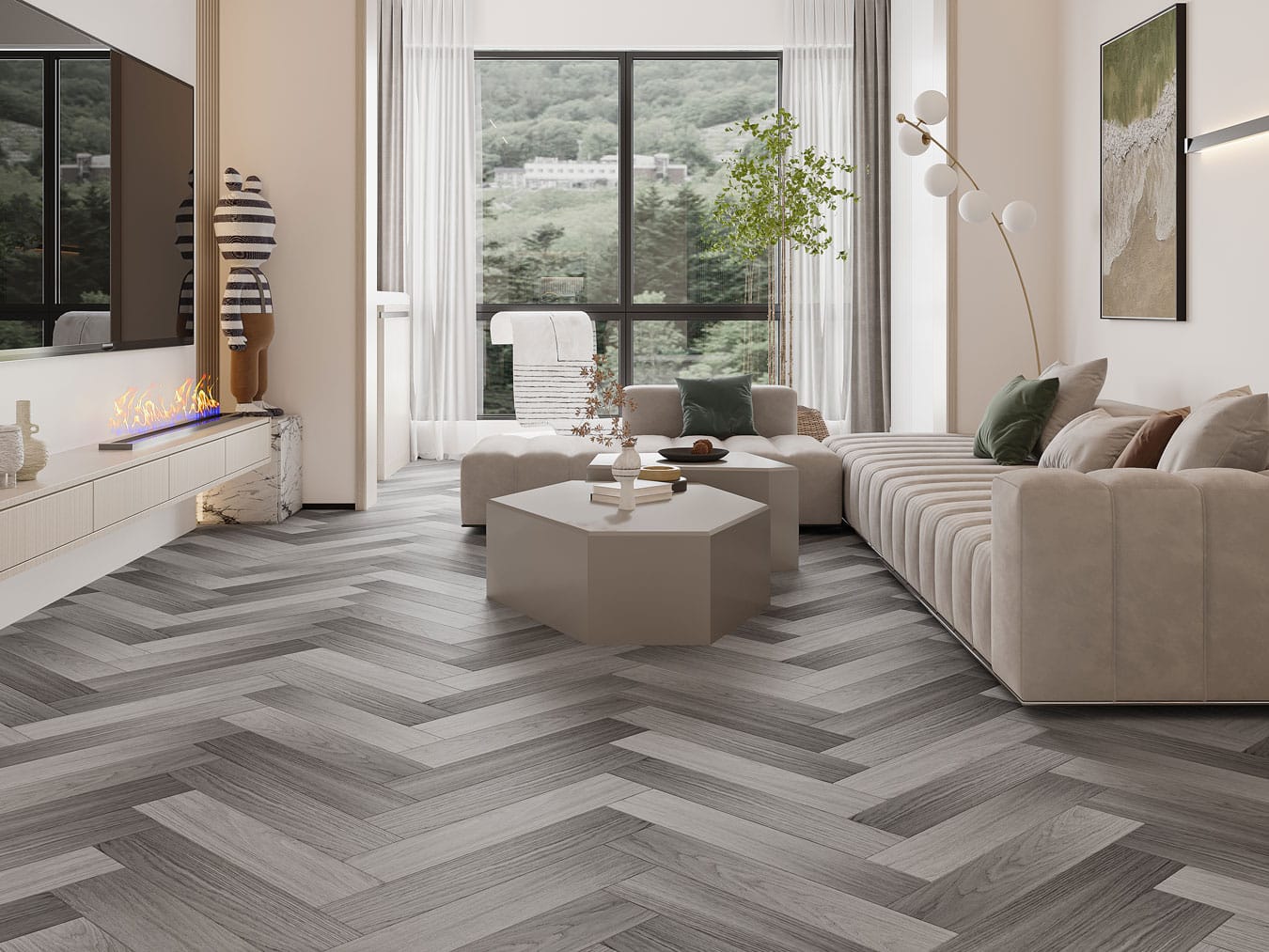
The herringbone pattern uses smaller floorboards and a specially designed click-lock system, allowing the planks to be installed diagonally at right angles to create a herringbone-like pattern.
Thanks to its unique installation structure, herringbone laminate flooring brings a distinctive and luxurious aesthetic effect to the space, often used in modern or neoclassical interior design styles.
However, due to the requirement for specialized floorboards and more complex installation techniques, the material and installation costs for herringbone laminate flooring are often higher than traditional straight lay patterns.
>> See more Beautiful, Creative Herringbone Laminate Flooring Patterns
In addition to core material and thickness, laminate flooring is also classified based on surface texture technology. This factor directly affects the realism of the wood grain, the feel when walking, and the slip resistance of the floor.
Embossed In Register (EIR) is a premium embossed surface technology, often found in European or Malaysian laminate flooring lines. The embossed lines on the surface perfectly match the wood grain printed on the decor paper, giving the floor surface a realistic feel similar to natural wood. As a result, when viewed at an angle or touched, EIR laminate flooring provides a more vivid and authentic feel compared to regular textures.
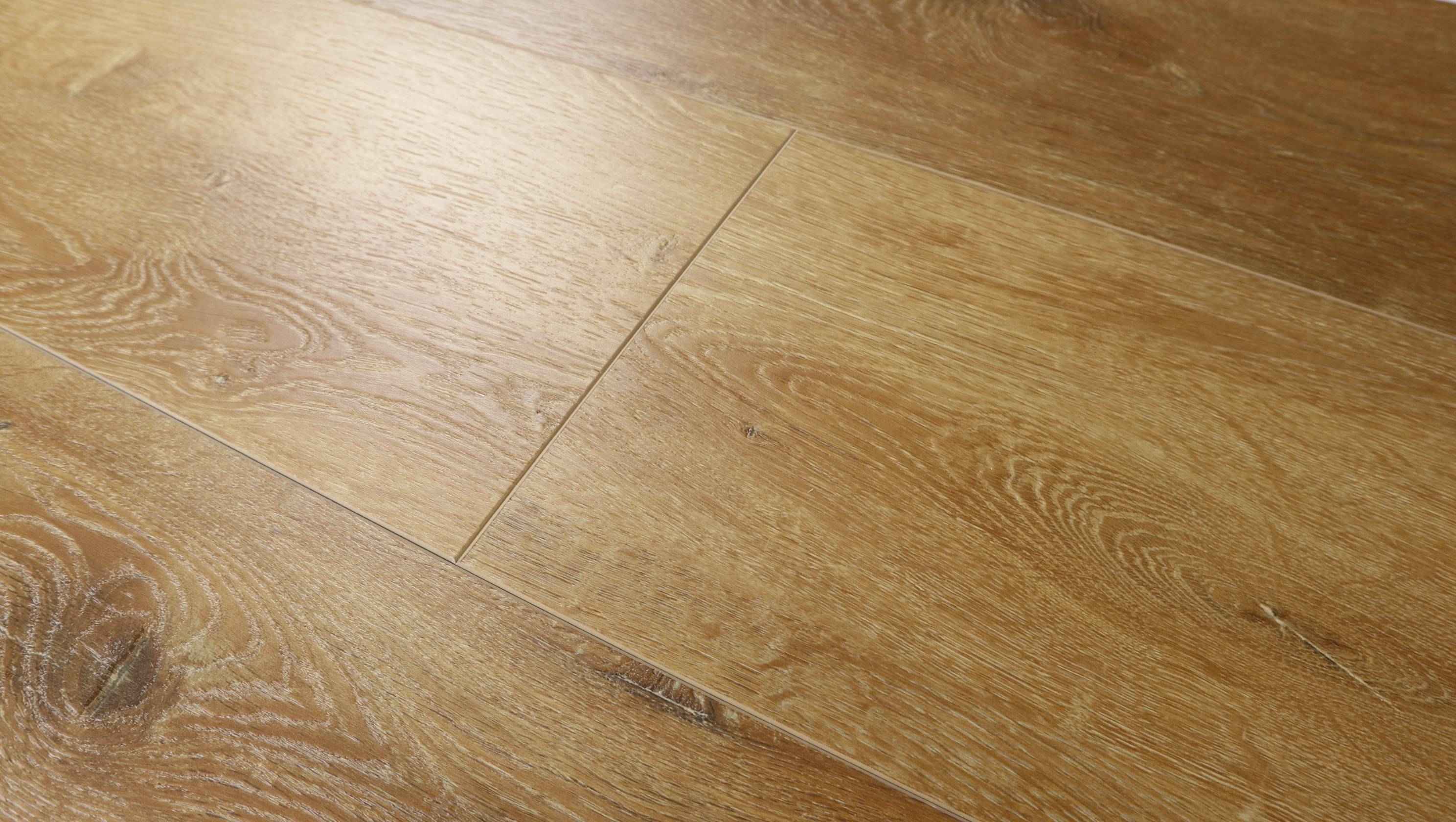
The surface of the floorboard is treated to be smooth and highly glossy, creating a light-reflecting effect as if coated with a layer of varnish. This style was once popular in the market about 10-15 years ago, especially in some inexpensive laminate flooring lines. However, this type of surface is now rarely used in modern laminate flooring lines.
The reason is that the overly glossy surface is prone to slipping when walking, and scratches on the protective overlay are easily visible after a period of use. Additionally, the strong glossy effect makes the wood grain less natural, no longer fitting with modern interior design trends that prioritize textured or realistic wood surfaces.

100% produced in Vietnamese factories in Hoa Lac, Hung Yen, Dong Nai, etc.
Characteristics:
Quality is continuously improving thanks to the application of technology transferred from Europe.
Diverse designs, updated according to Vietnamese tastes.
Competitive prices due to no import taxes.
Representative brands: Savi, Pago, Kosmos, Wilson, Morser, Fortune.
Price range: economical – mid-range, from 150,000đ – 350,000 VND/m².
>> See details: Latest Vietnamese Laminate Flooring Designs

Savi SV901 Laminate Flooring
Retail price: 210,000 VND/m²

Savi SV902 Laminate Flooring
Retail price: 210,000 VND/m²

Savi SV903 Laminate Flooring
Retail price: 210,000 VND/m²

Savi SV905 Laminate Flooring
Retail price: 210,000 VND/m²

Savi SV906 Laminate Flooring
Retail price: 210,000 VND/m²

Savi SV907 Laminate Flooring
Retail price: 210,000 VND/m²

Savi SV908 Laminate Flooring
Retail price: 210,000 VND/m²
Officially imported from Malaysia (Made in Malaysia), Malaysian laminate flooring is renowned as a


![PVC Wall and Ceiling Panel Price List [2026]](https://cdn.thienhafloor.vn/2025/08/tam-nhua-op-tuong-pvc-5__w1200.avif)


![PVC Wall and Ceiling Panel Price List [2026]](https://cdn.thienhafloor.vn/2025/08/tam-nhua-op-tuong-pvc-5__w320.avif)
